

Five Hours of Open Sparring!
The day is an open hall for all fencers to partake in open practice against other fencers in the room, get your fights in and compete against your friends. Or, even better, make new friends and then fight them!
Instructor seminars and team games will feature within the day, but if these do not interest you, there will be room to continue sparring in the hall.
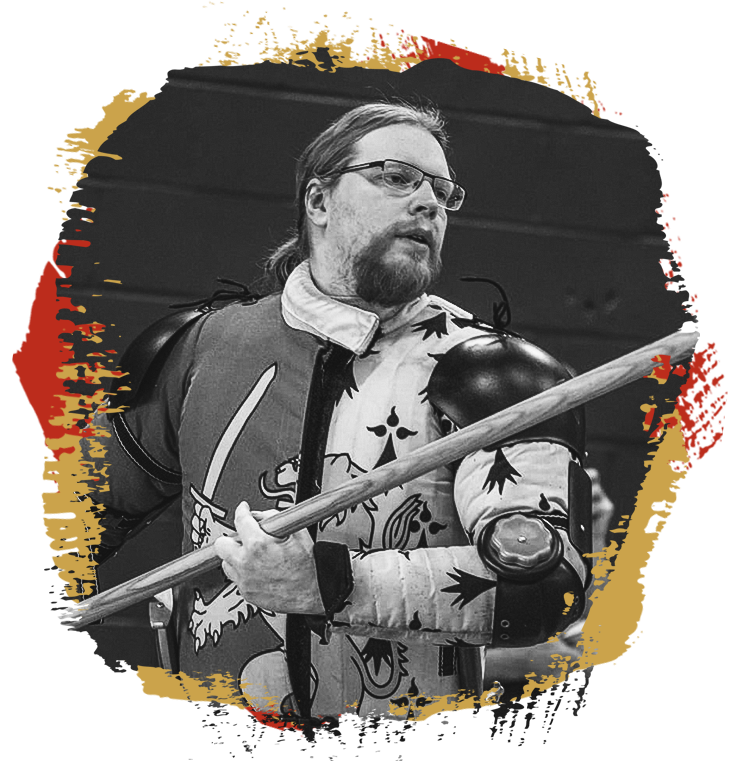
Seminar Instructor – Edmund Cameron James Withnell, Order of the Blade
Part 1: an intro to armour, and how to envision it when lacking the full components proper.
Preface: What is needed to get into armoured practise? At minimum, mask and gloves to get the idea of parts down. A chest guard would be ideal, but not essential.
– Exercise 1: With mask and gloves, and weapon of choice, let’s look at how to move in armour. First consideration is that with our harness, we might be facing vision restriction, breathing issues, etc, so movement should be limited and explosive. Guards need to be extremely narrow both for our stamina and to limit exposing vulnerabilities. With a weapon of arming sword length of greater, we should ideally start using halfsword. With anything smaller, we *can still* halfsword, but we can weight the advantages of simply keeping one armoured limb free to grab and wrap.
– For this exercise, both fencers should be in halfsword, points touching. From here, the attacker should look at moving the opponent’s point and sword to enter in with a thrust. This can be done by beating with out own point, using the centre blade between our hands to powerfully press away the opponent, or using our pommel to hook and beat away our partner’s point. Stepping strongly inward means we can dictate a close action from the word go, and get into the place where we have the most control.
– If using a weapon smaller than an arming sword, rather than needing to beat away the opponent’s sword, the smaller weapon can be used to block and press and the free hand used to wrap and grab. Alternatively, even a dagger can be halfsworded to get the maximum blocking capability. Likewise, when attacking the smaller weapon, the attacker should look to making the most of range to press the point into the most vulnerable areas (neck, armpit, etc).
– Exercise 2: Now we’ve got a working idea of how to move and what the targets are, we encounter a simple issue – armour moves, and those gaps aren’t available to us in motion. In addition, our opponent is trying to stab us right back, making things even harder. We might even get our point to touch, but still achieve nothing, either due to armoured segments, lacking force to pierce the padding or maille, or simply having a bad angle. As such, we cannot rely on a touch however strong (or light!) to be the finish. With this in mind, how are we to overcome the obstacles?
– For this exercise, the same lesson as exercise 1 can be done, but now, there is a focus not only on landing a touch, but on stepping closer to the opponent and pressing the point inward with more force. At close range, the point can be pressed in firmly enough to wound, however, we must assume that even pressing this momentum might not be enough; we have to struggle to get the deepest target we can, and work the point into it as best we can manage.
– Conversely, the defender wants to use all three parts of the sword to push the opponent away, and keep them from the narrow box that forms our vulnerable sections. In this exercise, the defender should make an effort to gently ward off the attacker; remembering that only a firm point to the target areas will even stand a chance of harm, the defender can even use their arms to parry and wrap the opponent’s sword!
Part 2: A moving fortress.
An armoured fighter is both extremely vulnerable to dying, and almost totally immune to injury. As such, moving in a way that limits how we can be slain is more important than preventing small touches as we have established so far. Subsequently, there are ideal guards to work from, as these limit our openings and threaten our opponent. These apply largely regardless of the type of weapon, and may be simplified into 4 guards we can work from.
Guard 1 – Upper guard (halfsword, held beside head, point forward)
Guard 2 – Middle high (halfsword held on dominant side, point angled toward the neck)
Guard 3 – Middle low (Same as Middle High, point aimed toward the knee)
Guard 4 – Lower side (held on non-dominant side, pommel forward, point back, halfsword)
– Exercise 3: In terms of attacking and defending, the best two guards to work from for a basic parry and counter, are guard 4 to guard 1. As the attacker places a thrust in at the neck, the defender can move from upper guard to lower side guard, parrying between the hands and pressing the pommel forward into the attacker. This wards off the incoming point by driving it down, and readies the defender to bring their weapon back up again with the point. Partners should give this a try, as making the ward correctly can be difficult, especially against committed thrusts.
– Exercise 4: Now we can look at how the middle guards (2/3) can play into things. As our legs are rarely a target in harness, the main advantage of a middle guard is we are stable and powerful, and can use these guards to press up or down. Take the same approach as exercise 3, with the defender using Guards 2 or 3, and receiving an attack by the attacker, transitioning to Guard 1 or 4. When doing these transitions, the defender should treat these transitions as aggressive wards, putting them into a new position that facilitates the following counter attack at a closer range.
Part 3: A host of weapons
While we’ve touched on armoured fighting against different weapons, we should also consider how weapons besides swords and daggers function against armour. Katana and Asian swords, sabres, rapiers, polearms such as spears and poleaxes, halberds, all function against armour in different ways, and have different ways of dealing with the obstacles. While all swords listed can be halfsworded, polearms can sometimes outright be used much the same as before while aiming for the vulnerable parts of the armour. Similarly, swords held in typical grips can still be deadly to an armoured fighter: low guards make use of the point driving forward in a thrust to reach the neck, armpit, and other vulnerable zones. Subsequently, good practice is to approach the concept of armour when facing multiple types of weapons, and moving against them.
– Exercise 5: If time allows, have people try out all weird and wonderful weapons they want to try against a defender. Keep things light, but experiment with various tools and methods now we have the basics in mind. In some ways, armoured fighting means that there’s only so many ways to do harm, so as long as we end up targeting those areas, the tool we use is almost irrelevant.
Part 4: Knights & Knaves
Fundamentally speaking, armour escalates fighting to a form of warfare; wearing armour for a fight is essentially a way of gaining a tremendous advantage, especially over unarmoured opponents. We should treat armoured vs unarmoured as similar to a modern tank vs a modern infantryman, with similar likelihood of the latter being blown away.
However, armour comes with its own drawbacks, much as modern armoured units have their own burdens. For a harness context, teamwork by many unarmoured fighters can bring the harness down; seizing the armoured fighter’s weapons and limbs, getting behind them, forcing their vulnerable areas to open, are all ways of achieving this. However, even in numbers, unarmoured fighters will fundamentally struggle when the armoured fighter might not even notice some hits.
Exercise 6: If time allows, this is a perfect chance to try a game, with 3 or more people IN FULL KIT.
– One person can be armoured, the rest are unarmoured. This is a light game, focusing on placing the point into the armoured player’s armpit, hand, elbow, or neck.
– The armoured fighter can touch the others anywhere. Understandably, the unarmoured players will generally find that without much cleverness, misdirection, and even trick actions, they still stand at a huge disadvantage to someone with protection.
– To further drive home the difficulty, the armoured player can outright ignore any touches they feel did not land with the point firmly enough; again, a single touch isn’t enough in most cases! How much harder is it to defeat the armoured player when a small hit accomplishes nothing?
To win, my lesson advice is to not keep at the edges of the armoured fighter, but to divide their attention and press in; while small touches accomplish nothing, firm actions up close into the small gaps of the armoured player will cause their downfall.
Thus do lighter infantry slay heavy infantry by force of numbers and savagery, and the lesson is complete.
Required equipment: Mask and gloves, a weapon of choice. Chest protector optional!
Admin Bits
The day is open to all those who have valid insurance for the practice of Historical Fencing. Please be prepared to present evidence of such if asked by a member of staff. Those who do not have insurance will be required to purchase it through the Order for the day, for a £5 surcharge.
After Party
A fter the day of sparring, we will be heading up the road to a pub called the Boat Inn, address below. There we will swap exploits of the day and grab some food and drinks before the drive home!
Boat Inn, 31 Shilton Ln, Coventry CV2 2AB